 hulryung.com
The New Member of the Chat Room Is an AI Agent
Should OpenAI Build Slack?
An interesting piece came up in the Latent Space newsletter: Why OpenAI Should Build Slack. The argument goes like this: Slack has neglected its developer community since 2019, and the "Slack AI" feature is half-baked at best. If OpenAI built a workplace chat tool designed from the ground up to be AI-native, it could redefine how we work entirely.
At first I thought this was a bit of a stretch. But reading further, I found myself nodding — especially at the part about "chat as the natural orchestration interface for multi-agent collaboration."
I've Used Them All
I've cycled through a number of chat services at work. Microsoft Teams, Slack, and I've even evaluated open-source alternatives like Rocket.Chat and Mattermost.
The bottom line: none of them fully satisfied me. Most are either add-ons bolted onto services we were already using, or part of some bundle deal. We use Teams because it comes with Microsoft 365. We use Slack because it's practically a standard in developer culture. We didn't choose the tool — the environment chose it for us.
So there's always been something missing. Messages pile up but information gets buried. You can search, but context vanishes. Channels multiply while the real discussions happen in DMs. You keep asking yourself, "Now where did we have that conversation?"
What's Missing from Chat
The fundamental problem with workplace chat is that only humans are talking.
Sure, there are bots. You can get Jira notifications, post CI/CD results to a channel, run slash commands like /remind. But that's notifications, not conversation. Bots react to predefined events — they don't understand context or actually participate.
Say you type "summarize the API spec changes from this deployment" in chat. Right now, a teammate has to dig through the docs and write it up. Request a PR review, and a reviewer has to carve out time to read the code. Ask for meeting notes, and someone has to compile them manually.
All of this could be different if there were an AI agent in the chat room.
What If an Agent Were a Colleague?
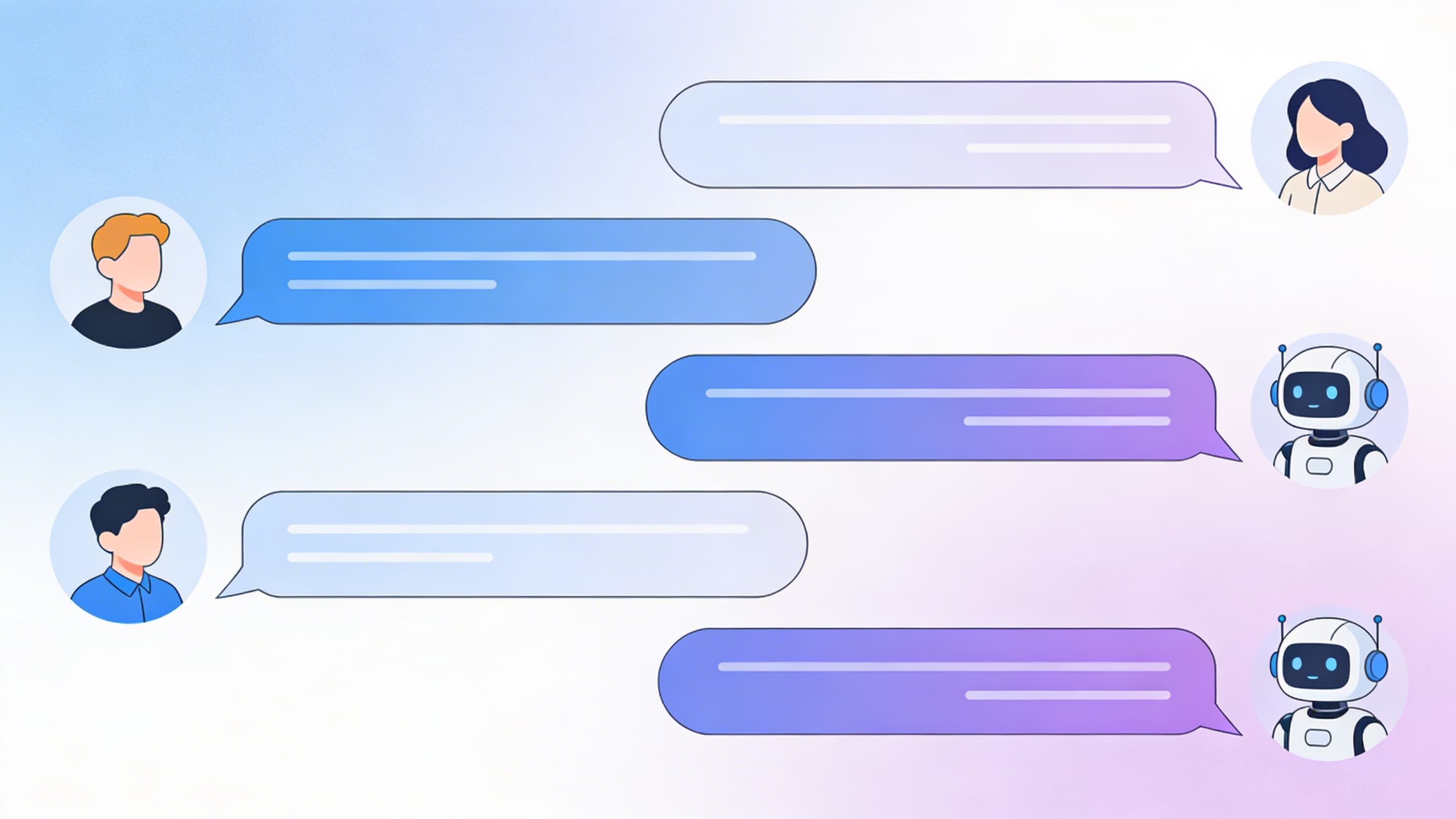
As LLM-based agents have matured, the potential of chat has fundamentally shifted. Instead of a dumb bot, imagine an agent that understands context and participates in conversation — a full member of the chat room.
Picture this: a code review agent sits in the dev channel. When a PR is opened, it automatically starts a review. Ask it "why was this written this way?" in chat, and it answers with full awareness of the PR's context. A designer says "can you tweak the spacing on this component?" and a frontend agent edits the code and pulls up a preview.
Going further: humans joining in on a conversation between agents becomes possible. The deployment agent and the monitoring agent are discussing "error rate went up 0.3% after this release — should we roll back?" and an engineer cuts in: "Hold on, that was expected. Keep it."
If today's chat is "humans talking with bots occasionally interjecting," the future of chat could be "agents and humans participating on equal footing."
Why Existing Services Can't Do This
Slack and Teams are bolting on AI features, but there's a fundamental constraint: existing chat services were designed with human-to-human conversation as the assumption.
Channel structure, notification systems, permission models, search indexing — all of it is built on the premise that "a person sends a message, a person reads it." Put AI on top of that and you get "a smarter bot," not "a colleague who participates in conversation."
That's the core argument in the Latent Space piece. Don't add AI as an afterthought — build chat where agents are first-class citizens from day one. Agents that join channels, debate in threads, collaborate with other agents, and ask humans for judgment calls when needed.
The Wall of Network Effects
Of course, this isn't easy. Workplace chat is an area where network effects are brutally strong. If the whole team is on Slack, switching is painful no matter how good the alternative is — "a chat only our team uses" is meaningless.
But then again, Teams did manage to crack Slack's dominance in a similar situation. The strategy of bundling Teams with Microsoft 365 found a way over the network effects wall. An AI-native chat tool could do something similar — naturally seeping into organizations that are already deep into AI tooling.
It's also worth noting that ChatGPT has already launched group chat functionality. Right now it's mostly people pulling in AI to answer questions together, but nudge the direction slightly and it starts looking like workplace chat.
In the End, It's About Who You Work With
The future of workplace chat ultimately comes down to "who you're working with." Today, we chat with fellow humans. Soon, AI agents will be colleagues too. The tools need to reflect that shift.
Not "a chat that has agents in it," but "a space where agents and humans work together." The difference isn't just a feature addition — it's a philosophical shift in design. And whichever service makes that shift first will become the workplace tool of the next era.
Maybe that's OpenAI. Maybe it's a startup we haven't heard of yet. What's certain is that today's workplace chat is not its final form.